Product Manager Portfolio: What to Include, Real Examples, and How to Build One
Learn what goes into a strong PM portfolio, see real examples of what works, and build yours without starting from a blank page.
A product manager portfolio is a curated collection of your work: the problems you owned, the decisions you made, and the outcomes that followed. It is not a resume with nicer fonts. It is where hiring managers and interviewers go when they want to understand how you think, not just what you shipped.
Most PM work is invisible on paper. Roadmap calls, scope tradeoffs, alignment across functions, and the things you chose not to build rarely show up in a job title or a bullet point. A resume alone rarely tells that story. A portfolio is where the decision-making process, the outcomes, and the proof of impact live together.
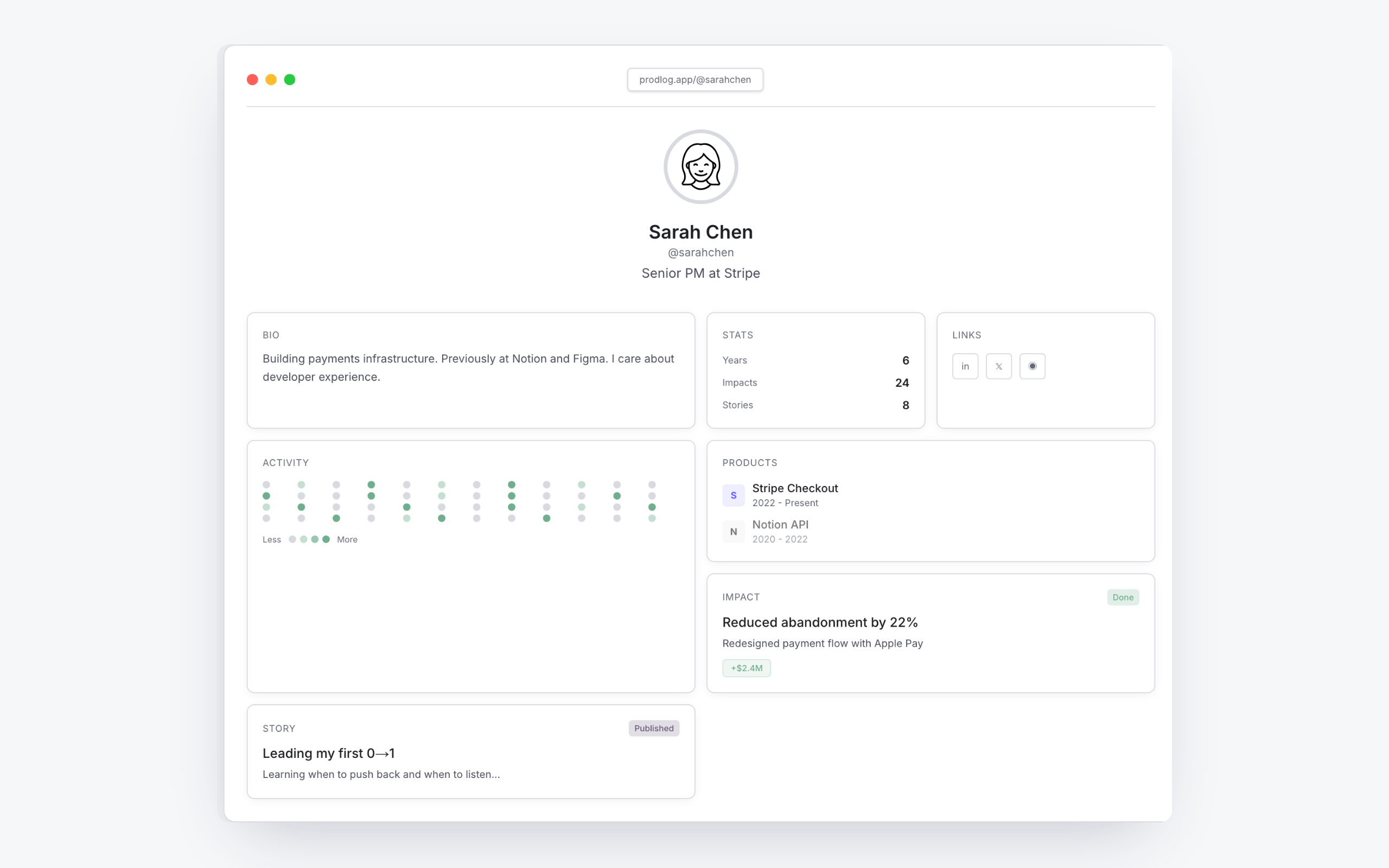
That does not mean every PM needs one. Plenty of strong product managers get hired without ever sharing a portfolio link. But when a candidate has one, and it is specific, current, and credible, hiring managers remember it. If you want a reference point while you read, see what a finished portfolio looks like.
Do product managers actually need a portfolio?
Honest answer: often no, especially for mid-level and senior PMs at established companies with structured hiring loops. Many interviews still run on resume screening, behavioral questions, and a case study or two. A portfolio is rarely a hard requirement in those contexts.
Where it genuinely matters:
- Transitioning into PM from engineering, design, consulting, or another function: you need evidence that your judgment maps to product work, not just adjacent experience.
- Moving into senior or staff-level roles where leadership expects demonstrated judgment across ambiguous problems, not just a track record of shipping.
- Interviewing at companies that ask for written work samples: product sense memos, strategy docs, or case studies are easier to produce when you already have a structured log of past work.
- Building a public profile: speaking, writing, advising, or recruiting inbound interest where people evaluate you before a conversation starts.
The maintenance problem is real. A portfolio only works if it reflects current work. Most PMs build one during a job search, use it for a few weeks, then let it go stale. The candidates who stand out are usually the ones who treated the portfolio as an output of ongoing documentation, not a one-time project assembled under deadline pressure.
What goes into a product manager portfolio?
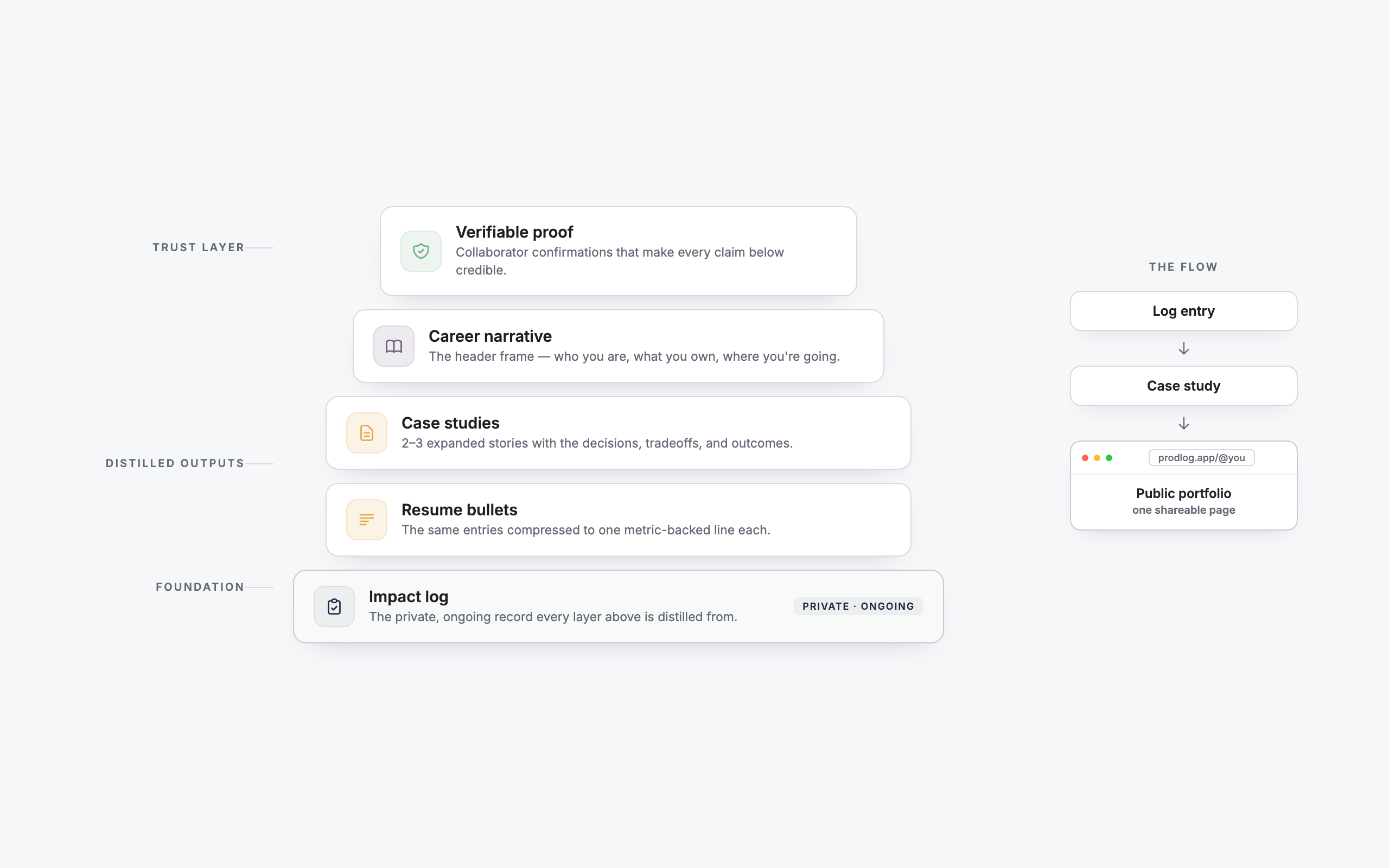
A strong PM portfolio is not one document type. It is a small system of related artifacts, each serving a different reader need. Five components cover most of what interviewers actually look for.
Work impact log. This is the running record of what shipped, what you owned, and what moved as a result. Every case study, resume bullet, and interview story is distilled from this raw material. Without it, you are reconstructing six months from memory every time you need to update anything. The same habit that powers a brag document is the foundation here: private, continuous, and detailed enough to defend under questions.
Case studies. Pick two to four initiatives and go deep. A case study shows your decision-making process, not just the outcome: what problem you were solving, what options you considered, what you chose and why, and what happened. These are the pieces interviewers quote back to you in later rounds.
Resume-ready bullets. Distilled from your impact entries, written around outcomes rather than tasks. "Owned checkout redesign" is weak. "Cut trial-to-paid drop-off by 18% by simplifying the upgrade path for annual plans" is usable. Your portfolio and your resume should tell the same story at different levels of compression.
Career narrative / about section. A paragraph or two on your arc, your focus areas, and the kind of problems you gravitate toward. Not a biography. Interviewers want a frame for the work samples, not your life story. What kind of PM are you? What do you tend to get pulled into?
Verifiable proof. Notes, stakeholder quotes, or collaborator endorsements that corroborate what you are claiming. This is what separates a strong portfolio from a self-promotional one. Anyone can write a compelling bullet. An engineer confirming that your scope call prevented a three-sprint detour carries weight a self-written paragraph cannot.
What makes a PM portfolio actually stand out
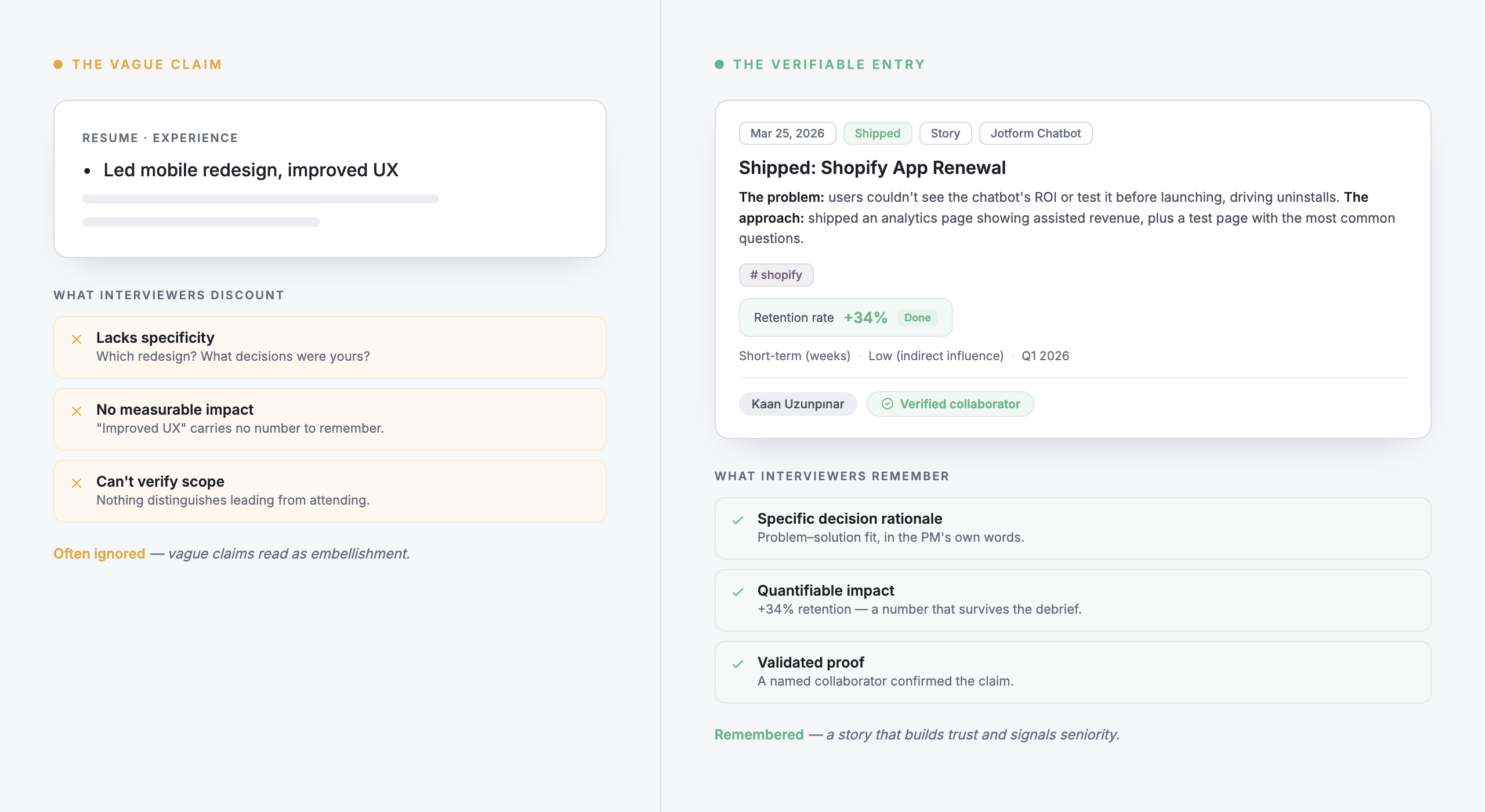
Interviewers and hiring managers see a lot of portfolios. The ones they remember share specific qualities. The ones they discount are usually recognizable within thirty seconds.
The decision log matters more than the launch list. Any PM can ship. Judgment shows in what you said no to and why. A portfolio entry that explains a deprioritization (the alternatives considered, the opportunity cost, the revisit criteria) tells a hiring manager more than a list of features you released.
Specificity beats scope. "Led mobile redesign for 2M users" sounds impressive until every candidate has a big-number launch. "Chose to cut personalization from v1 and redirect two sprints to onboarding, which moved week-1 activation by 9%" is smaller in scope and more interesting because it shows a bet.
Cross-functional credit that has been acknowledged. A verified endorsement from an engineer or designer carries more weight than a self-written bullet claiming cross-functional leadership. PM outcomes are collaborative by nature; external confirmation makes your account harder to dismiss as self-promotion.
A visible cadence. A portfolio that shows consistent logging over twelve months signals something different than one assembled the week before interviews. The timeline itself is evidence that you document impact as a habit, not a panic response.
Product manager portfolio examples
The examples below are illustrative entry types, not real people. Each shows the level of specificity that makes a portfolio entry defensible in an interview.
Hard-metric impact entry
2025 Q3- Initiative
- Self-serve annual plan upgrade path in billing settings
- Role
- Owned prioritization, scope, and launch sequencing. Final decision-maker on v1 cuts.
- Collaborators
- Eng lead, product designer, lifecycle marketing, data analyst
- Outcome
- Trial-to-paid conversion rose from 11.4% to 14.2% over eight weeks. Time-to-first-paid-action dropped by two days for annual-plan cohorts.
- Notes
- Deferred two billing edge cases to v2 to protect measurement window and launch date.
Judgment / decision entry
2025 Q4- Initiative
- Deferred AI-driven personalization for low-traffic enterprise segment
- Role
- Made the call after opportunity-cost review; proposed redirect to activation bottleneck instead.
- Collaborators
- Data science lead, enterprise sales engineering, revenue ops
- Outcome
- Avoided a multi-sprint build with weak near-term upside. Freed capacity for onboarding fixes that lifted activation +9% in pilot accounts.
- Notes
- Documented reversal criteria and a six-month revisit date so the deferral did not become a silent no.
Leadership / process entry
2026 Q1- Initiative
- Cross-team decision log standard for initiatives touching three or more squads
- Role
- Authored template, ran pilot with two eng managers, drove adoption through planning rituals.
- Collaborators
- Three engineering managers, staff designer, PM peer group
- Outcome
- Planning review cycles dropped from two rounds to one on most initiatives. Fewer reopened scope debates mid-sprint.
- Notes
- No single revenue metric moved. The win was coordination cost and execution confidence.
Swipe to see more examples →
How to build a product manager portfolio (step-by-step)
- 1
Start with the log, not the design
The biggest mistake is building a portfolio website before you have underlying content. Content first. Open a doc, a Notion page, or a dedicated logging tool and start capturing entries as work happens. If you need a starting structure, use a brag document template: the format maps directly to portfolio raw material.
- 2
Identify your 5 to 8 strongest entries from the past two years
Look for entries with the clearest outcome, the clearest role, and something interesting about the decision. A strong metric helps. A clear judgment call helps more than a vague "drove alignment" entry. You do not need twenty case studies. You need a short list you can defend in detail.
- 3
Expand 2 to 3 into full case studies
Structure each one: problem framing, what you considered, what you decided and why, what happened. Three hundred to five hundred words each is enough. Write for a skeptical reader who will ask "why that option?" and "what would you do differently?"
- 4
Write your career narrative
Two paragraphs maximum. What kind of PM are you? What problems do you tend to find yourself working on? What is the arc of your career so far? This section orients the reader before they dive into individual entries.
- 5
Get at least one entry confirmed by a collaborator
One real external confirmation changes how everything else reads. Ask an engineer, designer, or cross-functional partner to confirm a specific claim: the scope call, the tradeoff, the outcome. You do not need endorsements on every entry. One is enough to signal that your account is corroborated, not invented.
- 6
Choose your format
Hosted tool, personal website, or Notion/Google Doc. Match format to your target context. A startup interview may be fine with a clean Notion page. A company that values polished written work may expect something more designed. The content matters more than the container, but the container should not create friction you will not maintain.
PM portfolio formats: which one is right for you
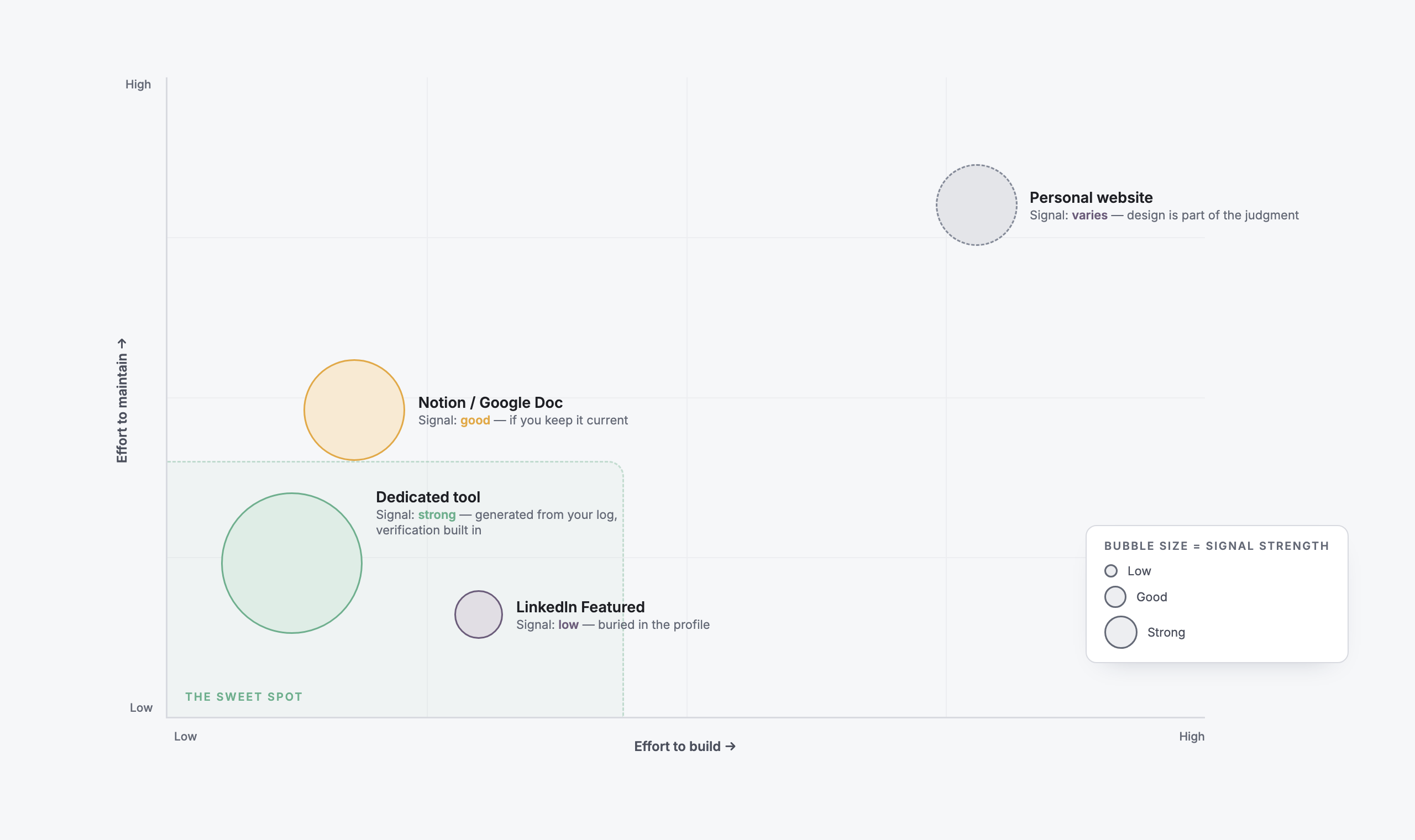
There is no universally correct format. The right choice depends on how much design control you want, how often you will update, and who will read it.
Personal website (Webflow, Squarespace, etc.). Full design control and a persistent public presence. Most work to build and most work to maintain. Best for PMs who want a long-term personal brand, not just a job-search artifact.
Notion or Google Doc. Fast to build, easy to update, shareable with a link. Can look unpolished, and that is acceptable at most companies. Interviewers care about the substance of your case studies, not whether you picked the right font.
A profile's "Featured" section. Zero effort, almost zero signal. Useful as a fallback link in an application, not a strategy. Treat it as a pointer to something better, not the portfolio itself.
Dedicated PM portfolio tools. Built for this use case: structured content by default, no design decisions required, outputs generated from logged entries. Best when the underlying content already exists and you need a shareable product manager portfolio website without rebuilding the structure every time you add an entry.
The maintenance problem: why most PM portfolios go stale
The best time to build a portfolio is during the job you are in, not the search you are starting. That is also when most people do not think they need one, which is exactly why so many portfolios feel thin when deadlines hit.
Logging impact consistently requires a trigger and a habit, not just good intentions. Two failure modes show up repeatedly:
-
Logging only at review time. You sit down in November and try to reconstruct six months from Slack search, calendar gaps, and vague memory. The entries come out shallow. The metrics are approximate. The decision rationale is gone.
-
Building the portfolio website first. You spend a weekend on layout and navigation, then run out of momentum before populating it with content. You end up with a beautiful empty shell.
The log is the portfolio. If your entries are specific, timestamped, and outcome-oriented, the formatted output almost generates itself: case studies, resume bullets, interview prep, and a shareable page are all views on the same dataset.
That is the problem Prodlog is built around. You log entries from the web, Slack, email, or iOS, in a line or two, where work already happens. Collaborators can confirm an entry, so your account is corroborated, not just claimed. The same entries prep your 1:1s and draft your reviews, and when you change jobs, your log becomes your portfolio. Publishing it is free. If you want the mechanics, see how it works. If you want to inspect the output first, see a real one.
FAQ
Do I need a portfolio to get a PM job?
Not always. Many PM roles hire on resume, behavioral interviews, and case exercises alone. A portfolio helps most when you are changing careers into PM, targeting senior or staff roles, or applying somewhere that expects written work samples. It is a differentiator, not a gate.
What's the difference between a PM portfolio and a PM resume?
A resume is a compressed screening artifact: one page, optimized for recruiters and ATS. A portfolio shows the reasoning behind the bullets: the tradeoffs, the context, the proof. They should tell the same story at different depths.
How long should a product manager portfolio be?
Two to four case studies plus a short about section is enough for most interviews. Quality and specificity matter more than length. A single well-documented initiative with clear decision rationale beats ten shallow launch summaries.
Can I show work from a job where I signed an NDA?
Usually yes, at the concept and outcome level. Describing the problem you solved, the options you considered, and the result (without proprietary screenshots, internal tool names, or unreleased roadmap details) is standard practice. When in doubt, anonymize the company context and avoid anything that could identify unreleased product plans.
What's the best format for a PM portfolio?
The one you will actually maintain. A clean Notion page with strong case studies outperforms a polished website that has not been updated in eighteen months. Match format to your audience: startup loops often care about substance; some companies expect a more designed presentation.
Start building your portfolio
Your portfolio is only as good as the log behind it. Log your work as it happens, and when you change jobs, your log becomes your portfolio. Publishing it is free, and so is getting started.